Google
 
Showing posts with label Map. Show all posts

Monday, July 9, 2007

Military activity in Afghanistan: updated to 7th July

The post about military activity in Afghanistan (and the maps) has been updated, now it covers until 7th July (lacks some days).

Saturday, June 30, 2007

Civilian deaths on NATO-ISAF operation (Haidarabad, Afghanistan)

NATO-ISAF airstrikes in Haidarabad village (Haydarabad, Ḩeydarābād, Hyderabad, Heydarabad, Khaidarabad) left at least 30 civilians killed or wounded on Friday June-29.

Haidarabad is at Gereshk district (Helmand province). Follow this link to see the map of Haidarabad.

Taliban forces tried to ambush an US-Afghan military convoy in
Gereshk district, and then they ran to the nearby village for cover. Then, NATO-ISAF attacked the village with airstrikes, said Dur Ali Shah, the mayor of Gereshk.

NATO-ISAF spokesman stated that a dozen of Taliban were killed in two engagements, but they weren't aware of civilian casualties.

Local sources stated that there have been intense fighting in the area, and there would be about 100 people killed.

This incident is one more in a long list. Last week, president Karzai criticized the ISAF "extreme" use of force.

Read more here:
- About the incident at Haidarabad: [Afgha News] [Yahoo News] [Bassirat.net] [BBC News] [El Mundo] [New York Times] .
- A local investigation reported that
62 insurgents and 45 civilians were killed in the operations [Yahoo News, Sunday 1st July].
- NATO-ISAF operations with civilian deaths : Civilian deaths and friendly fire on ISAF operations (Afghanistan) [updated] , Civilians killed by NATO at Afghanistan : the case of Zerkoh Valley (Shindand, Herat) .


Friday, June 22, 2007

Afghanistan: military activity on June 20 2007

The latest news about military activity in Afghanistan state that:

  • There have been fierce fighting in Chora district (Uruzgan). NATO and Afghan forces recovered the district after 3 days battle, leaving about 100 people dead including civilians. [Aljazeera] [BBC].
  • Afghan police recovered the Myanesin (or Myanishen or Mian Nisheen) district (Kandahar) on Tuesday 19-June, after the Taliban took it on Monday 18-June [Rferl] [Bassirat] [BBC] [Bassirat].
  • Taliban took the Ghorak district (Kandahar) on Monday 18-June, and it is still in their control [BBC] [Bassirat].
The following map show the position of the places:


Although
Afghan authorities said that Ghorak district is not strategic, we must see that is neighbor to the strategic Kajaki dam and to the conflictive Sangin valley. The mountains at Ghorak dominate these places.

Monday, June 18, 2007

Kajaki Dam: is still a fighting area

Kajaki dam, a key facility at southern Afghanistan, is still a fighting place between ISAF and Taliban.


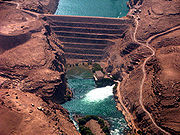
Kajaki dam is is one of the major hydroelectric power dams of Helmand province, and also serves to irrigate 1800 km² of land. The dam is 100m high and 270m long, and has a capacity of 1.2 km2 of water. Then, this dam is a key facility for the development plans of the Afghan government and its allies.

The pictures [Wikipedia] show the dam and the powerhouse.


The dam was built in 1953. In 1975, USAID supported the installation of two generators of 16.5 MW. In October 2001, the powerhouse was bombed by US Air Force.

Now, one generating unit is working and produces 16.5 MW. A second one is scheduled to return to service in 2007. And a third one (18.5 MW) is has been contacted China Machine Building International Corporation, and it is planned to be completed in 2007.


Kajaki dam has been a fighting place between ISAF and insurgents. In December 2006, Britan's commander stated that the area were fully controlled by ISAF. But the claim showed to be premature in February, when Taliban seized several towns. During February 2007, ISAF forces executed Operations Kryptonite and Volcano. These operations focused on some villages at the north-west of the dam, which were occupied by Talibans. The main battles occurred at Barikju, Chinah and Shomali Ghulbah.

The map below shows the main places in the area.


After the operations of February, the situation seemed to be under ISAF control. But recent military actions show that the area is still in middle of fighting.
In the last two weeks there have been several air strikes or similar operations.

  • 31-May. A-10 dropped a general-purpose 500-pound bomb on a compound near the Kajaki dam area.
  • 4-June. B-1B Lancer performed a show of presence over a coalition route in Kajaki Dam.
  • 5-June. RAF GR-9 Harrier monitored coalition forces in direct contact with insurgents in Kajaki Dam. Also, F-15Es dropped munitions on buildings within an insurgent compound. The aircrew also strafed the areas around the compound with cannon rounds.
  • 10-June. RAF GR-9 Harrier dropped 500- and 540-pound bombs on buildings in Kajaki Dam. After this, ISAF forces still received fire from the buildings. This finished after a second drop. F-15Es dropped GBU-38s on a compound in Kajaki Sofla.
  • 11-June. RAF GR-7 Harriers fired rockets at insurgents in Kajaki Sofla after coalition forces received heavy fire from the area.
This military activity shows that the area is still not fully controlled by ISAF.

Moreover, an article of Ron Synovitz [RFE/RL, Global Security] states that the area is not still safe enough to complete the repairs on the hydroelectric facility.

US and British military officers told district elders that construction projects will not proceed as long as locals continue to support Talibans. Each offensive of ISAF has forced the Taliban out of the area. But the main problem is to avoid the Taliban to came back.

The situation around Kajaki dam involves several aspects, from purely military, to the relationship between local Pashtun population, and also the relationship with the drug local economy.

Saturday, June 2, 2007

Military activity in Afghanistan: (29th May - 7th July 2007).

This post presents the military events in Afghanistan in the period 29th May to 7th July, and places them in the map.


The US Central Command Air Forces (CENTAF), reports the following air activity:


The geographic distribution shows a concentration of activity in the South West (Helmand, Kandahar, Farah Provinces), but also activities in the East and North. The places were occurred more air strikes are Garmsir, Sangin, Tarin Kowt, and Kandahar. Clashes have been concentrated on north Helmand, north Kandahar and south Oruzgan.

It is important to note that there is still fighting at Kajaki Dam. This is a strategic point, and the ISAF forces couldn't completely control since some months ago. Although the Operation Kryptonite (February 2007) cleared the area from Talibans, they have been carrying out a permanent guerrilla which destabilizes the area.

Other new fact is the clash at Kalāt-i-Nazar Khān, a remote Afghan-Iranian border post (the 17th June). In the fighting were killed 8 Taliban and 2 policemen.

Suicide bombers attacked the 16th June in Kabul and Mazar-i-Sharif. Both attacks were centered in military-civilian convoys.


The involved planes were: B-1B Lancer, F-15E Strike Eagle, A-10 Thunderbolt II, Royal Air Force GR-9 Harrier, and MIRAGE 2000. The bombs were: GBU-31 and GBU-38.


Other news sources are [Bassirat] and [AfghanNews].


Friday, May 25, 2007

Military Air Bases at Central Asia

Here is a map with military air bases at Central Asia (Afghanistan, China, Iran, Kyrgyzstan, Pakistan, Tajikistan, Turkmenistan, Uzbekistan). Use the right frame to find the bases.


Central Asia has always been a strategic region, due to different factors in different history periods. The main current factors are related with the routes for oil pipelines (from Azerbaijan, Kazakhstan and Turkmenistan), narcotics production which is currently one of the main economic activities (mainly in Afghanistan), the neighboring of emerging and existing powers (China, India, Russia) which join the Shanghai Cooperation Organization (SCO), regional conflicts (Kashmir, Afghan civil war), and the presence of highly militarized and unstable countries and societies.

In this context, the main actors have been installing military bases, where two of the main actors (USA and Russia) use the bases of other countries (Afghanistan, Uzbekistan, Kyrgyzstan).